
HABOKU / THIRD-PERSON BOSS RUSH 2026
After Boneyard, I wanted to go back to third person and focus on one thing: boss fights that feel good to play.
Haboku is a boss rush. A ronin painted every man he had been on a single scroll; one night the ink broke and the figures walked off the paper, wearing his face. Three bosses, three past selves, and after each fight he steals one of their techniques.
The look is a custom ink post-process inspired by Japanese sumi-e: paper, brush-weight outlines, flat ink washes and mist that fades the world into the page.
Everything is built entirely in Blueprints in Unreal Engine 5.8.3.
Download the playable build.
CREDITS :
Game Design & Development : Julien Pietri (Third Hand) with the help of Claude (for guidance and debugging)
SYSTEMS
Combat & Techniques
Base kit plus two stolen techniques, picked up one boss at a time:
Combo: a fast three-hit melee string
Dash: a short dodge with invincibility frames
Special: a far-reaching gap closer, counter-proof, used on bosses and by the player alike
Counter (stolen from Kasure): block an attack, then strike back
Ring (stolen from Nijimi): a shockwave slam with its own meter, staggers anything it catches mid-attack
Bosses
Three fights, each built from the same player moveset, turned against you:Kasure: a masked assassin with twin daggers, fast and close, phase 2 adds his own Counter
Nijimi: a soldier with a long nodachi, slow and heavy, phase 2 adds the Ring
Haboku: the final boss, a ronin with a spear who carries every technique in the game — combo, special, Counter and Ring together in phase 2
Every boss telegraphs each attack with a readable freeze pose, breaks into a harder phase 2 past half health, and can be staggered by poise damage.
ProgressionNo currency or upgrades: progression is unlocking a stolen technique after each boss
Counter after Kasure, Ring after Nijimi, both carried into every fight after
A technique is only shown on a reward card once it's actually been built and works
Save & PersistenceOne save value: which arena the player has reached
A new game picks up exactly where the last boss left off, with the right techniques already unlocked
Level DesignA straight boss-rush line: three arenas, no hub, no detours
Each arena is built around its boss — Kasure's village, Nijimi's forest, Haboku's mist-and-rock void
Transitions between arenas fade through paper, never a hard cut
UI & PresentationStory cards between fights: the boss's name, his personal seal (a kanji carved in red), a short verse, then the outcome text
A matching ink illustration behind every card and the main menu, framed so the centre stays clear for text
Typography in Shippori Mincho, a brush-feel serif that reads like a woodblock print
A dedicated reward card for each stolen technique, shown only once it exists in the build
Look & SoundA custom ink post-process: paper-colour backgrounds, brush-weight silhouettes, mist that fades distant shapes into the page
One shared score across all three fights: calmer in phase 1, faster drums in phase 2
Every attack carries its own sound cue, built from the base character packs
DESIGN DEVELOPMENT
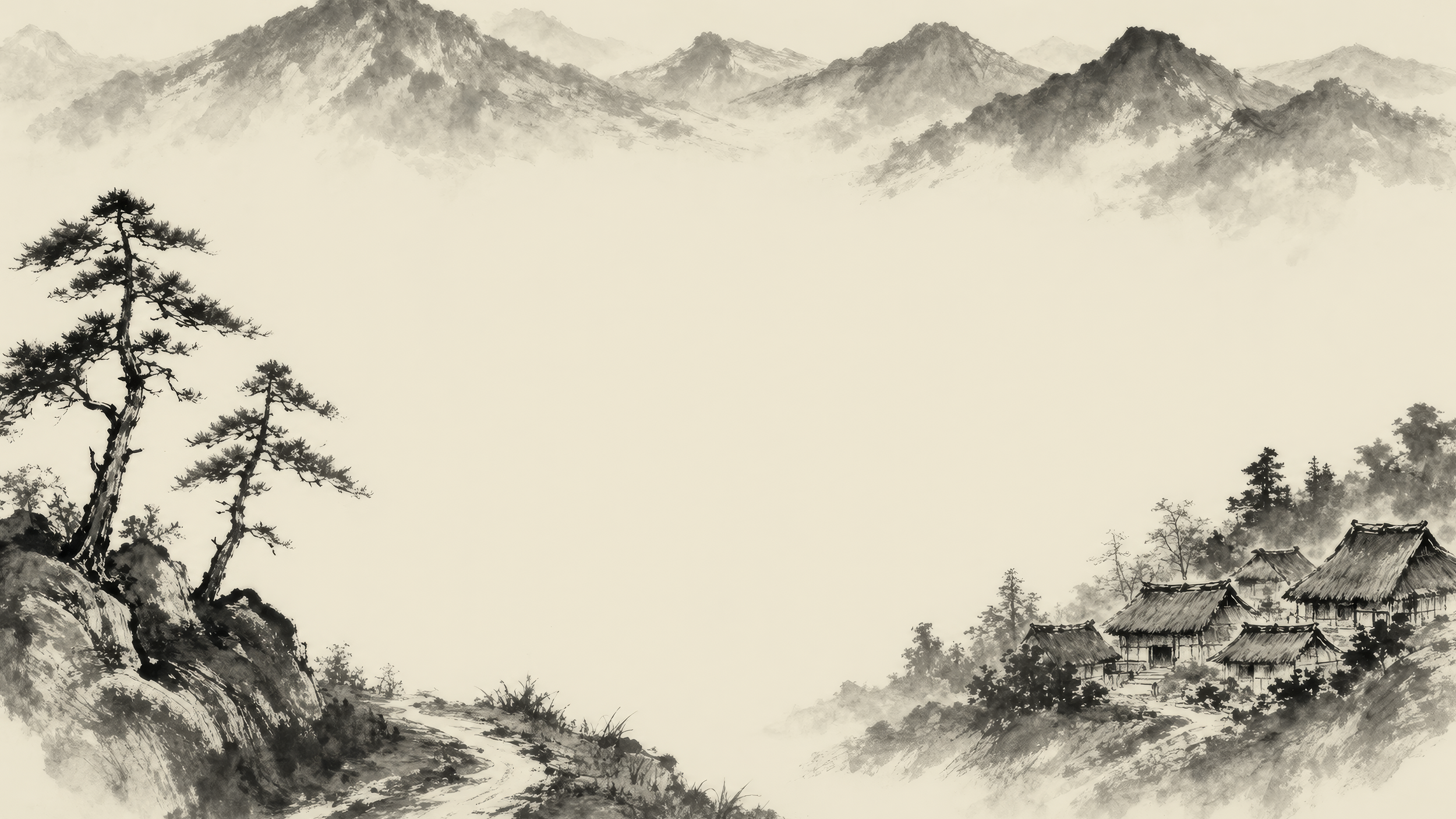
A.I. Gen Prompt : Misty layered mountains along the top edge, a small village of thatched roofs in the lower right corner, two tall pine trees on a rock in the lower left, a narrow path winding out of the bottom edge. Traditional Japanese sumi-e ink wash painting, black ink on plain white paper, loose expressive brush strokes, soft grey washes, dry-brush texture. Composition: all elements placed along the edges and corners; the centre of the image is completely empty white paper. No colour, no text, no calligraphy, no signature, no red seal, no border, no frame. 16:9.
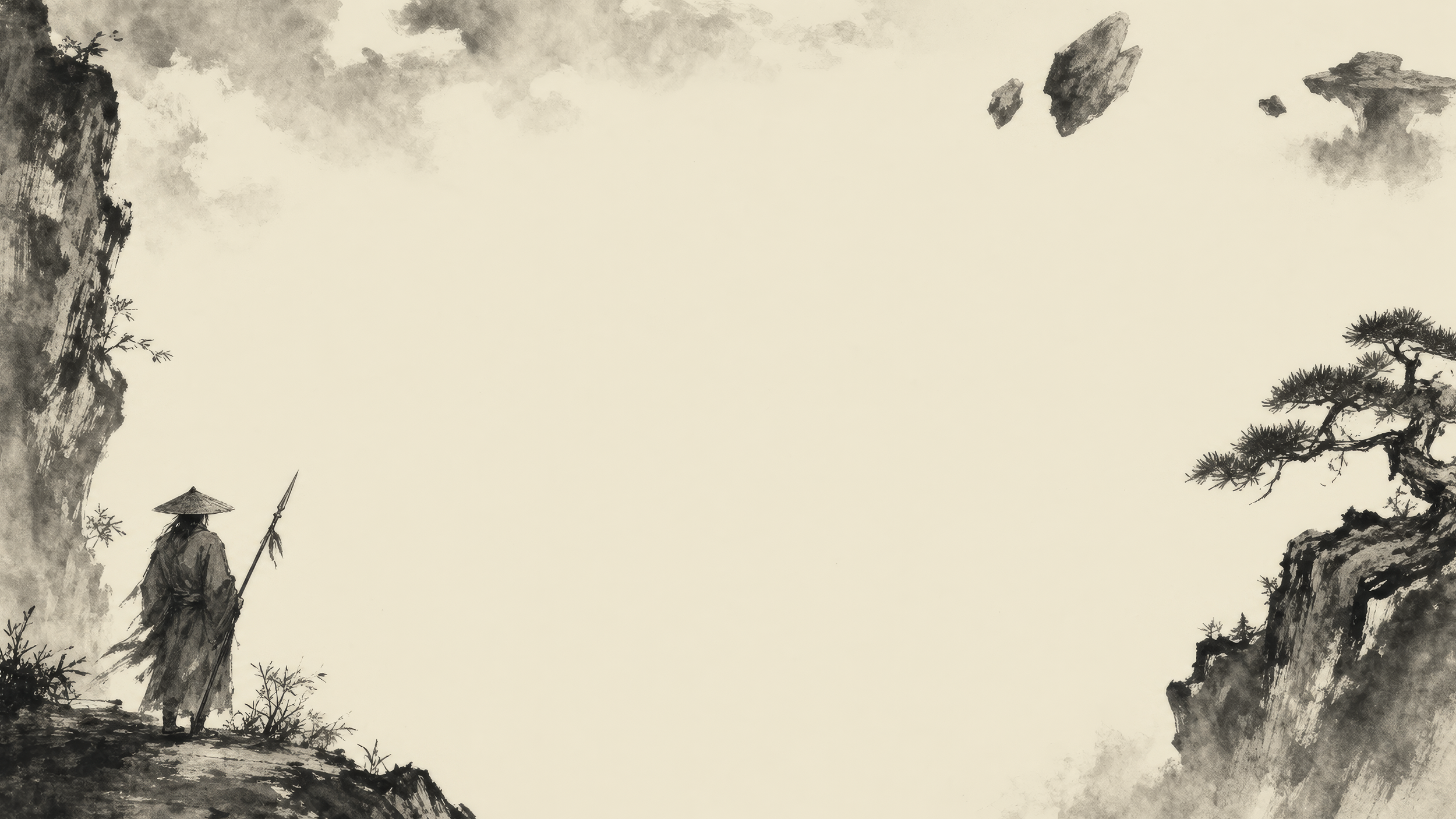
A.I. Gen Prompt : A lone ronin with a conical straw hat and a spear, standing small in the lower left corner, seen from behind. A few floating rocks and empty mist along the top edge. Traditional Japanese sumi-e ink wash painting, black ink on plain white paper, loose expressive brush strokes, soft grey washes, dry-brush texture. Composition: all elements placed along the edges and corners; the centre of the image is completely empty white paper. No colour, no text, no calligraphy, no signature, no red seal, no border, no frame. 16:9.
Process
Reference
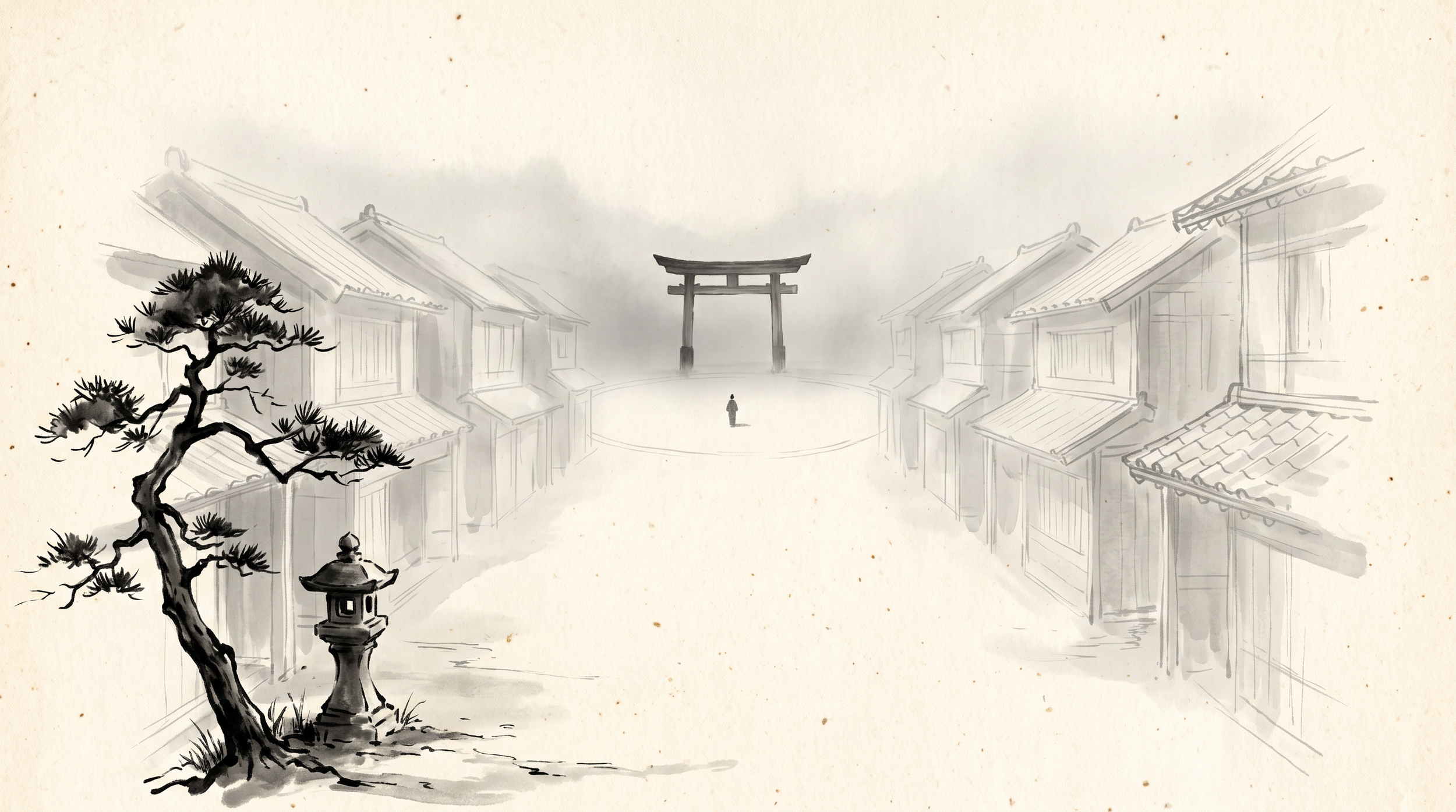
Final Level in Engine